Threading the Projector While the Lights Dim: America's Last 35mm Hands
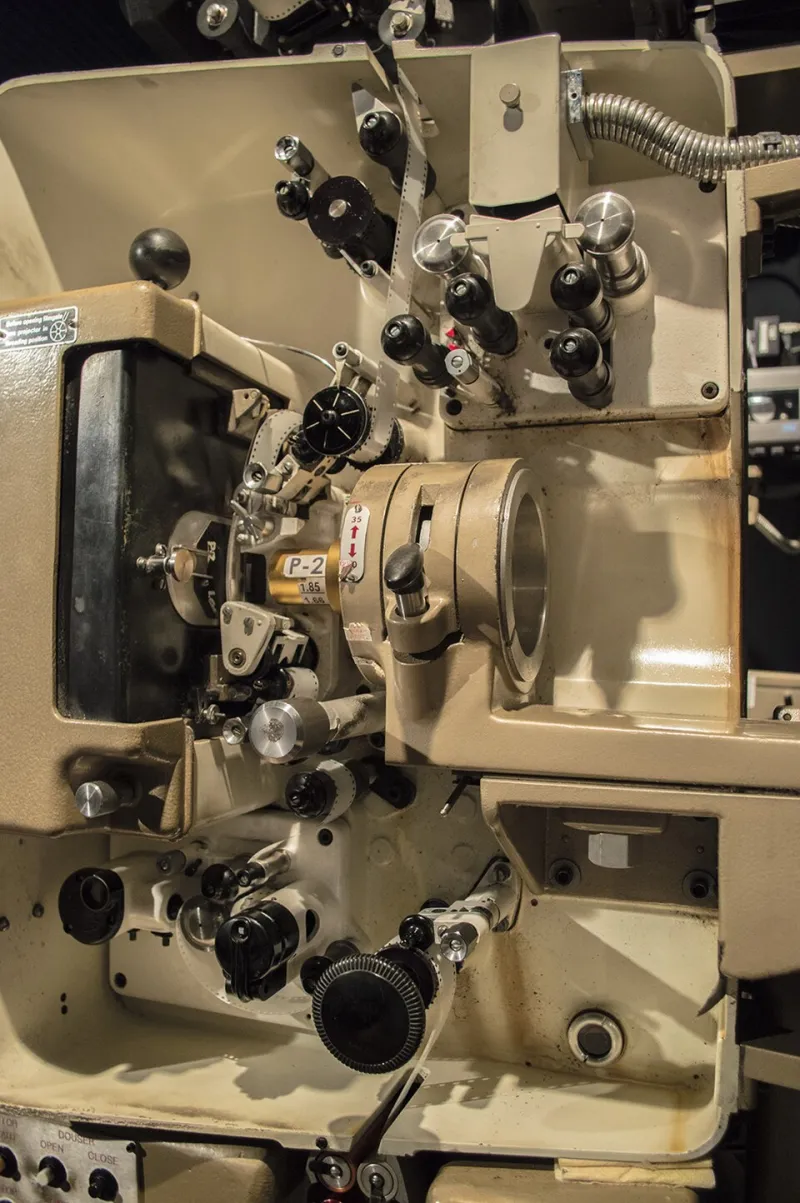
Photo: Leo Enticknap, CC BY-SA 3.0, via Wikimedia Commons
The booth above the Nuart Theatre in Los Angeles smells faintly of dust and warm machinery. Forty feet below, the Friday night crowd is settling into their seats for a repertory screening of a 1974 crime drama. Up here, Marisol Vega is on her knees beside a pair of projectors, holding a strip of celluloid up to a work light, hunting for the cue marks.
"People think I'm up here pressing play," she says, laughing. "I'm up here keeping a 50-year-old machine alive for two hours straight."
Vega is one of a shrinking number of full-time film projectionists in the United States — people who still know how to splice, thread, repair, and rescue an actual reel of movie. There's no industry body counting them anymore, but the consensus among the folks we spoke with is that you could fit most of them into one theater.
When the Prints Stopped Coming
The math is brutal and simple. Shipping a 35mm print of a feature weighs roughly 60 to 90 pounds across six reels, costs hundreds of dollars to make and move, and degrades with every screening. A hard drive weighs a couple of pounds and copies infinitely. Studios began the switchover in earnest in the early 2010s, and by mid-decade, most American theaters had ripped out their projectors or relegated them to storage.
But film never fully died. A handful of directors — Quentin Tarantino, Christopher Nolan, Paul Thomas Anderson among them — kept insisting on photochemical finishes and 35mm releases. Repertory houses like the Alamo Drafthouse's legacy locations, the Music Box in Chicago, and Seattle's Grand Illusion kept their projectors oiled and their booths staffed.
"Every time a studio announces a 70mm or 35mm engagement, my phone rings," Vega says. "Nobody trained the next generation. The people who know this stuff are retiring, and the prints are still out there."
The Craft Nobody Sees
A projectionist's shift starts hours before the audience arrives. Prints arrive in heavy hexagonal cases and have to be built — the six or so reels spliced together onto one giant platter — then inspected for damage, cleaned, and threaded through a maze of rollers and gates. During the show, the operator watches for cue marks, makes reel changes on older two-projector setups, and listens for the sound of a scratch or a warp before the audience ever notices.
In small-town theaters, the job never really left. The Storyville Cinema in rural Kentucky still runs 35mm several nights a week, mostly because owner Dale Pruitt never saw a reason to stop.
"Dish network goes out, fine. Projector bulb blows, I fix it," Pruitt told us by phone, the hum of his carbon-arc-era machine audible behind him. "But when that print comes down from the booth and it's got a scratch in reel three? That's mine. That's a mark I made. There's something about that."
Pruitt learned the trade from his father, who ran the same booth starting in 1959. He estimates fewer than a dozen people in his state could thread a projector from memory today.
Why Filmmakers Are Fighting For It
Here's the part that surprises casual moviegoers: some directors prefer film not out of nostalgia, but because of how it looks and how it disciplines the process. Celluloid's cost per minute forces deliberate choices on set. Its grain and halation render light in ways digital cameras still imitate rather than replicate. And a print is a physical object — one that can sit in a vault for a century and still be played, no firmware required.
"A DCP is a file. A file needs an ecosystem," says an independent filmmaker we spoke with, who shot her latest feature on expired stock and hand-delivered prints to three theaters herself. "A print just needs a projector and someone like Marisol."
That's the real anxiety in the booth: not that film will vanish, but that the knowledge will. Machines can be restored. The hands that run them can't be downloaded.
Passing It Forward
Vega has started informally training a 22-year-old usher at her theater, teaching him to splice on scraps of trailer reel. Pruitt runs occasional open-booth days where locals can watch a print get built. And film societies across the country — from Austin to Portland to a converted barn theater in Vermont — have begun staging 35mm weekends specifically to keep the skill economically viable.
"Every screening is a little act of stubbornness," Vega says, as the projector's shutter begins to clatter and the light throws itself at the screen below. "The audience doesn't have to know. They just have to feel it."
The lights dim. The leader counts down. Somewhere in the dark, a craft that's supposed to be dead flickers back to life, twenty-four frames at a time.