Silence Isn't Free: The Recordists Selling the Quietest Places in America
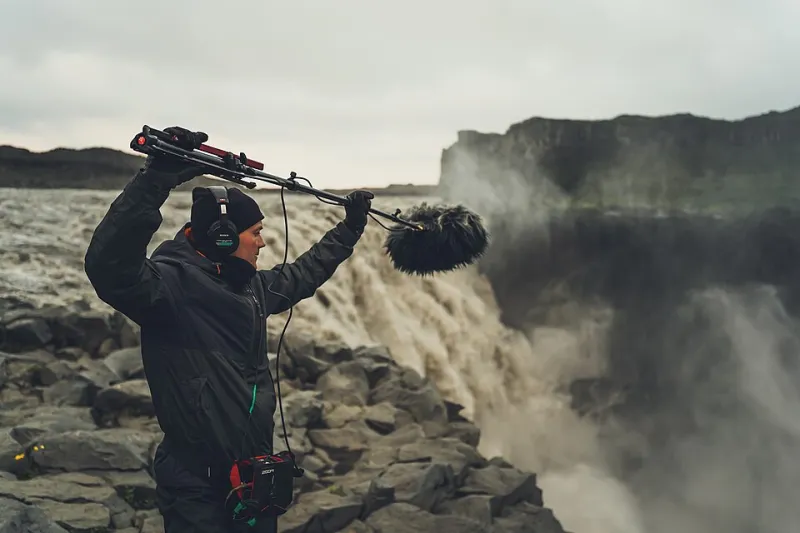
Photo: HerrOlli, CC BY-SA 4.0, via Wikimedia Commons
There's a moment in most indie films you've never noticed because it's doing its job perfectly. The scene cuts to a porch in rural Montana. The dialogue stops. And underneath it all, there's a feel — crickets doing their thing, wind nudging a screen door, a distant dog with opinions. That's not the location where they shot the movie. That's a file. Somebody recorded it, possibly years earlier, possibly a thousand miles away, and licensed it to the production for a fee.
Welcome to the world of wild sound — ambient audio captured on location, apart from any shoot, and sold or shared to filmmakers who need a place to sound like. It's one of the least glamorous corners of independent film, and according to the people who do it, one of the most misunderstood.
The Silence Economy
Mara Ellison has spent four mornings in a row lying in the grass outside Cheyenne, Wyoming, with a pair of microphones suspended in what's called an XY configuration, waiting for what she calls "the good nothing."
"People think silence is the absence of sound," she told us over a thermos of gas station coffee. "Silence is a texture. Prairie at 5 a.m. has a different grain than a cornfield in Iowa. Your ear knows. Even if you don't know you know."
Ellison is one of a small but growing number of American recordists building sound libraries specifically for indie productions — productions that, increasingly, can't afford to send a sound crew to capture the real thing. A feature shot in a Brooklyn warehouse might need a Michigan lake, a New Orleans streetcar, a Utah canyon at dusk. Licensing a pre-recorded ambience costs a few hundred dollars. Flying a recordist to Utah does not.
And here's the part that surprises people: the most valuable recordings often aren't the loud ones. They're the quiet ones.
"Authentic silence has become a commodity because it's basically extinct," says Devon Park, a recordist based in Detroit who specializes in urban ambiences. "You try recording 'empty diner at 6 a.m.' and you've got an HVAC unit, a refrigerator hum, a truck doing engine braking on the highway half a mile out. Getting a clean, genuinely quiet room tone from a real American space? That takes planning. That takes money."
How much money? Park says boutique libraries have licensed single pristine room tones — minutes of near-silence from a specific location — for four figures. "A production designer gets a screen credit. Nobody ever thanks the person who made the silence."
Why Indie Films Sound Better Than They Should
Talk to working sound designers on micro-budget productions and a pattern emerges: the movie sounds bigger than its budget largely because of these libraries. A film shot entirely in a single Los Angeles apartment can feel like it moves through a whole city, as long as the audio world outside the frame is convincing.
"Picture is a lie. Sound is the lie that makes the lie believable," is how one editor put it to us, only slightly apologizing for the cliché.
The craft here is invisible by design. If you notice the sound, something's gone wrong. The best wild sound is the audio equivalent of a great background actor — present in every frame, credited to no one.
The Open Book
What we love about covering this beat at Project Danus is that the recordists themselves are increasingly working in the open. Ellison posts her recording rigs, her failures (a full day ruined by a distant crop duster), and her pricing on her site. Park runs occasional livestreams from his van while capturing Detroit's dawn ambiences, chat scrolling past as he waits for a freight train to pass.
"People deserve to know how the sausage gets made," Park says. "Also, honestly, it's nice to talk to somebody. You spend a lot of time alone with a microphone, being very quiet."
There's something fitting about that. The most solitary craft in filmmaking, dedicated to capturing absence, finding its audience by finally making some noise about itself.
So the next time an indie film transports you to a prairie, a diner, a porch at dusk — and you never notice how — somewhere, someone earned that. Possibly while lying in wet grass. Definitely for less money than you'd guess.