Borrowed Porches, Named Neighbors: When the Credit Roll Doubles as a Town Ledger
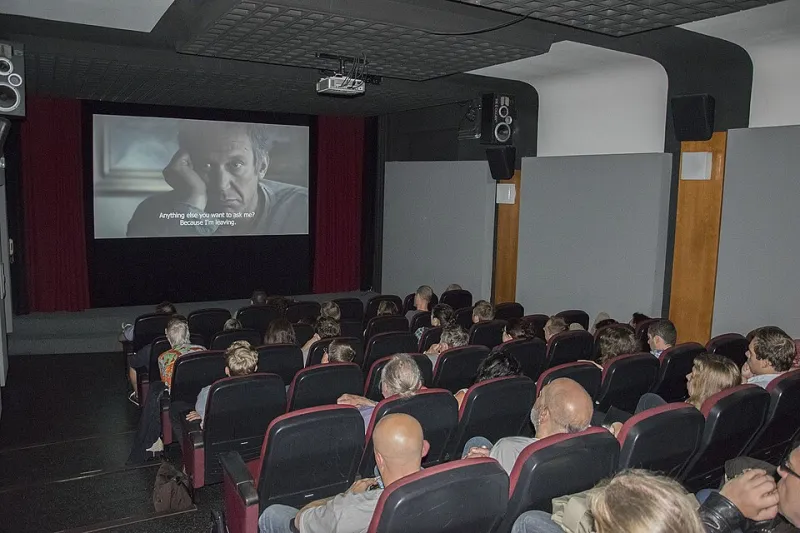
Photo: Elena Ringo, CC BY-SA 4.0, via Wikimedia Commons
The house lights come up, but nobody moves. On screen, the credits are still rolling—not the compressed streamer version, but the full, stubborn, locally sourced roll. There is the pastor who lent the fellowship hall. There is the hardware store that donated paint. There is the neighbor who let a crew run an extension cord through her kitchen for three days and only asked that nobody step on the hydrangeas. The audience reads it like a box score.
That is the strange, generous thing happening in a corner of American independent film right now: the end credits are becoming a community record. Not just a list of union requirements and postproduction vendors, but a map of who showed up. A film made with a town rather than merely in one tends to leave a paper trail, and increasingly that paper trail is projected on a wall.
The Roll as a Rolodex
Most credit rolls are designed to satisfy contracts, guild rules, and the legal fear that someone, somewhere, will be left off and call a lawyer. That is the baseline. But micro-budget filmmakers have always used the back half of the movie for something else: accounting for favors. When your budget is twelve hundred dollars and a lot of goodwill, the credit roll is where you pay people back in the only currency you have—public thanks.
A borrowed ladder becomes a line item. A church basement becomes a location credit. A local mechanic who fixed the production van on a Sunday gets a special thanks. These rolls read like a Rolodex of a specific place at a specific time. They tell you which diner stayed open late, which print shop rushed the posters, which family let the crew use their bathroom without turning it into a whole thing.
That is not incidental. It is a form of civic bookkeeping. The credits say: this movie did not materialize from a cloud. It came through doors that were opened by people who live here.
A Receipt for Borrowed Things
There is a mutual-aid ledger quality to the best of these credit rolls. They document the invisible economy of indie production: the borrowed truck, the donated coffee, the friend who did sound for gas money, the city council member who helped untangle a permit. In a normal industry film, those transactions disappear into a budget line. In a scrappy local production, they often appear by name.
That matters because favors are fragile. A credit is not a paycheck, but it is proof. It says the filmmaker remembers. It says the church basement was not just a free room; it was a contribution. For volunteers who may never work on another movie, seeing their name on a big screen—even a sheet hung in a library—can be the whole point.
It also creates a public record of how the film was made, which is useful for the next filmmaker. A credit roll that names the diner, the venue, the sound guy, and the permits office is basically a starter kit for someone else's production. It is open-source production knowledge disguised as a thank-you note.
Tourism, Accidentally
Some of these rolls function as tourism pitches whether the filmmakers intended it or not. A movie set in a small town that lists the actual businesses—the bakery, the feed store, the motel with the good sign—turns the credits into a visitor's guide. Viewers who loved the light in a particular scene can trace it back to a real place. That is not a marketing campaign. It is a byproduct of specificity.
And specificity is the point. A credit roll that says "special thanks to the town of [wherever]" is polite but vague. A credit roll that says "special thanks to the owner of the Bluebird Diner for the pie and the parking lot" is a different document. It treats the town as a collaborator, not a backdrop. That distinction is showing up in how filmmakers talk about location scouting, too: less "we found a look" and more "we found a neighbor."
The Names That Don't Fit
There is a harder conversation underneath all this. A credit roll can be a community record, but it can also be a selective one. The people who show up on screen are not always the people who carried the most weight. Unpaid labor, undercredited crew, and local volunteers can get flattened into a single "special thanks" line while the director's dog gets a card. The roll is not automatically equitable just because it is long.
Filmmakers who take this seriously tend to treat the credit block as part of production, not postproduction cleanup. They collect names and roles as they go. They ask people how they want to be listed. They check spelling. They make room for the church basement and the mechanic and the neighbor with the hydrangeas. It is a small craft decision with a civic aftertaste.
Make the Last Scene Count
At Project Danus, we keep coming back to the idea that independent film is made in the open—not just the shooting, but the accounting. The credit roll is the last scene of that openness. It is where a movie admits what it borrowed and who helped. It is a local paper printed in tiny type and projected at twenty-four frames per second.
So next time you stay for the credits—and you should—read them like a neighborhood. You might find a town in there.