Cinder Blocks and Blackout Curtains: Inside the Backyard Soundstages Americans Built Themselves
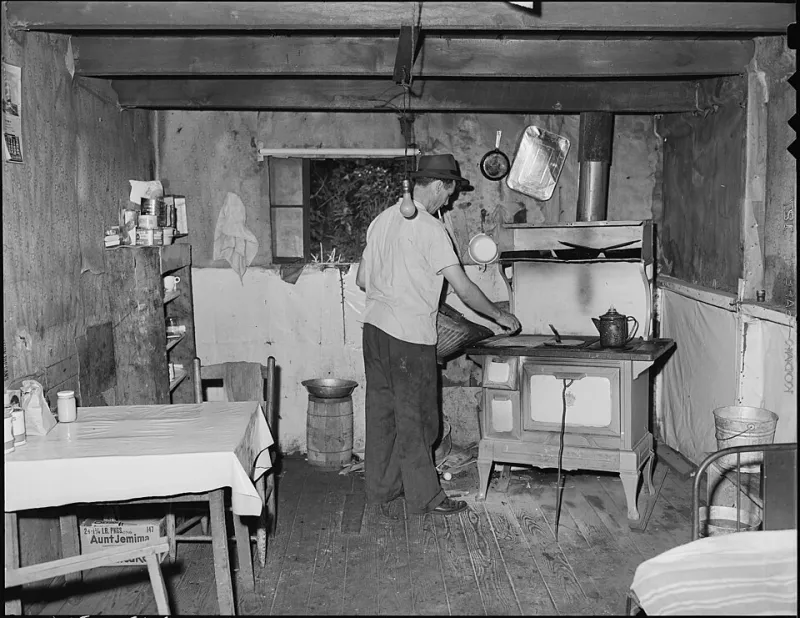
Photo: Russell Lee, Public domain, via Wikimedia Commons
There's a moment on every indie production when the numbers stop making sense. Maybe it's the quote from the rental stage in Atlanta — $2,800 a day, four-hour minimum, and you have to be out by 6 p.m. sharp. Maybe it's the realization that the location fee for the bar you wanted costs more than the camera. For a certain breed of American filmmaker, that moment is when they stop looking for a studio and start building one.
We spent the last few months visiting — sometimes in person, sometimes over increasingly long video calls — the homemade soundstages scattered across the country. Not the fancy warehouse conversions with proper HVAC and insurance riders. We mean the real ones: the two-car garage in Mesa, Arizona, where a complete western was shot over eleven weekends. The Vermont barn with a hole in the roof that the owner calls "my free soft light." The suburban basement outside Columbus where the ceiling is exactly six feet tall and the director wouldn't have it any other way.
None of these people set out to be studio owners. They just got tired of asking permission.
The Western in the Garage
Let's start in Mesa, because it's the most audacious of the bunch. Marcus Delgado and his brother converted their late father's two-car garage into a shooting space for Dry Season, a black-and-white western that ended up running 94 minutes. A western. In a garage. In suburban Arizona.
The trick, Delgado explains, is that they never tried to make the space look like anything. "We shot everything in deep shadow or against black. The garage became a saloon interior, a jail cell, a stable — whatever we needed — because we only ever saw ten feet of it at a time." They built four rolling wall panels out of plywood and 2x4s, each one dressed differently, repositioned as needed. Total spend on the walls: $612, most of it at a Home Depot on Apache Junction.
The full breakdown, which Delgado shared without hesitation: $612 for wall panels, $340 for a used LED panel array off Facebook Marketplace, $190 for blackout fabric from a fabric warehouse that sells by the bolt, and roughly $150 in miscellaneous gaff tape, clamps, and extension cords. Under $1,300 to build a stage that hosted an entire feature. The rental quote they'd gotten in Phoenix for equivalent days? Somewhere north of $19,000.
"The garage smelled like motor oil for the first three weekends," he laughs. "We decided it was atmospheric."
Pool Noodles Are a Legitimate Acoustic Solution
Sound is where homemade studios live or die. Anyone who's ever heard a garage door rattle on a take knows this. Which is why nearly every builder we talked to has a sound story, and most of them involve pool noodles.
The logic is real, if unscientific: the foam breaks up flat reflective surfaces, costs about a dollar apiece at any Walmart in America, and comes in colors that double as cheap production design. In Vermont, the barn studio run by the collective Hollow Brook Pictures has an entire wall of sliced pool noodles behind the dialogue areas, painted matte black. Does it match a properly treated vocal booth? No. Does it get dialogue clean enough for a small movie? Absolutely.
Hollow Brook's space is the most romantic of the bunch — a 19th-century dairy barn with a wood stove, a dirt floor they covered in rubber mats, and that famous hole in the roof. "November through March, we can't shoot in there because of the cold," says co-founder Priya Raman. "But that hole gives us this gorgeous diffused daylight for about four hours a day the rest of the year. We scheduled an entire short around where the sunbeam landed."
Their total build cost, over three years of gradual improvements: about $4,200, including a used lighting package and the rubber flooring. They rent it out to other local filmmakers for $50 a day, which mostly covers the wood stove's appetite for firewood.
The Moving Wall Trick, Explained
If there's one hack that showed up at every single space, it's walls on wheels. Locking casters from a hardware store, a basic frame, and suddenly you can reconfigure a room between setups instead of between shoot days. The basement studio outside Columbus — run by a married couple who shoot stop-motion and live-action hybrid work — has six of them, and their floor plan changes so often they keep a chalk diagram on the wall.
Other tricks we collected along the way:
- LED skies: A big softbox with a blue-magenta gel, bounced off white fabric, reads as sky through a window in any interior shot. Cost: under $100 if you already own the light.
- The ceiling problem: Six-foot basements can't hold overhead lights, so the Columbus couple mounts lights on the walls and bounces everything off white ceiling paint. "Our whole space is basically a softbox," they told us.
- Sound blankets from moving companies: Cheaper than actual sound blankets, identical function, and you can find them used.
- Paint is set design: Five gallons of dark paint transformed the Mesa garage more than anything else they bought.
Why Bother?
Here's the honest part: not everyone should do this. A garage studio is a commitment of years, not weeks. It eats weekends. It will strain a marriage if one spouse didn't sign up for plywood in the living room. The Vermont barn took three winters of gradual work before it was truly usable.
But every person we spoke to said some version of the same thing: owning the space changed what they were willing to make. When your studio costs you nothing per day, you can shoot a scene eleven times. You can start a western in a garage with no guarantee anyone will care. You can fail slowly, privately, and keep going.
That's the real product these spaces manufacture. Not square footage — permission.
If you've built your own shooting space, we want to see it. Send photos, cost breakdowns, and pool noodle counts to the Project Danus inbox. We're keeping a running list.